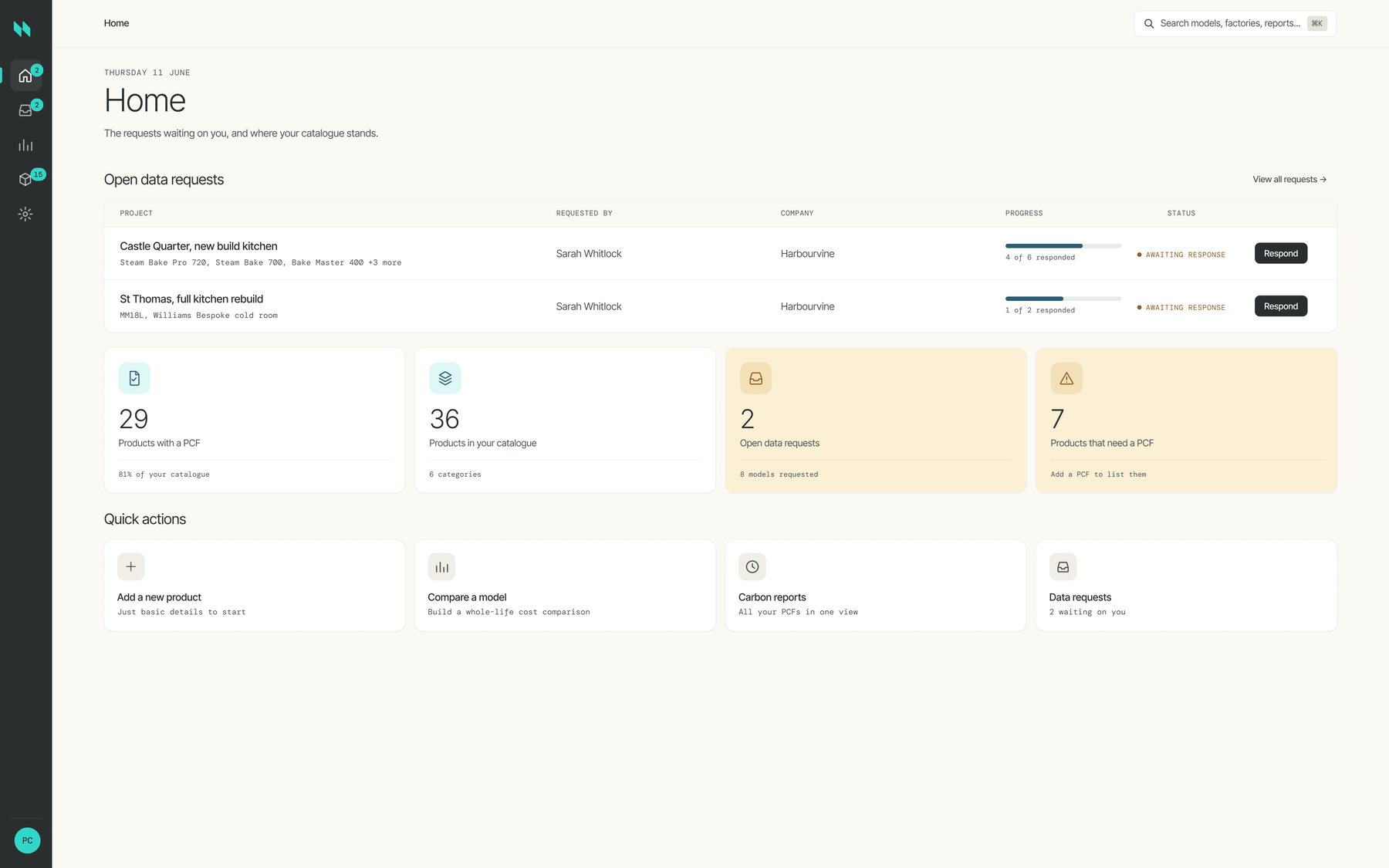
The home dashboard: open data requests, catalogue coverage and what needs a PCF, at a glance.
An data-driven asset-intelligence platform that gives buyers and manufacturers the data to decide on whole-life cost and carbon, not sticker price.
The home dashboard: open data requests, catalogue coverage and what needs a PCF, at a glance.
Most commercial equipment is bought and sold without knowing its whole-life cost, energy, maintenance, service life, replacement cycles. Cheap upfront products can cost estates millions over time. Niscai shows the full picture, with the right data at the point of decision.
It serves two sides: buyers who compare products on whole-life cost in seconds, and manufacturers who prove their products win long-term against cheaper alternatives. I lead the UX/UI and set up streamlined design workflows to move from concept to validated direction faster.
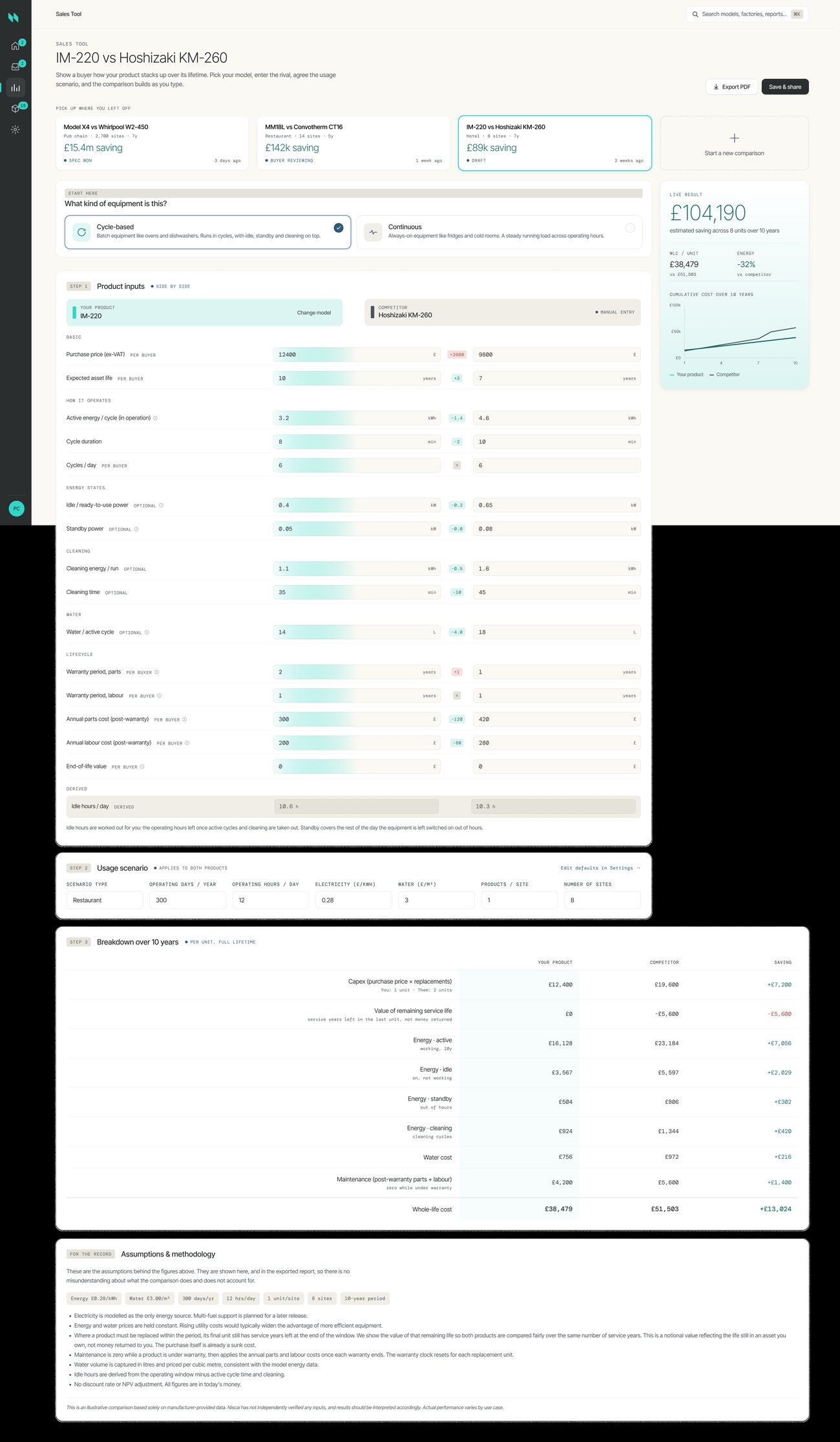
The whole-life cost comparison tool: enter a rival and a usage scenario, and the saving builds line by line as you type.
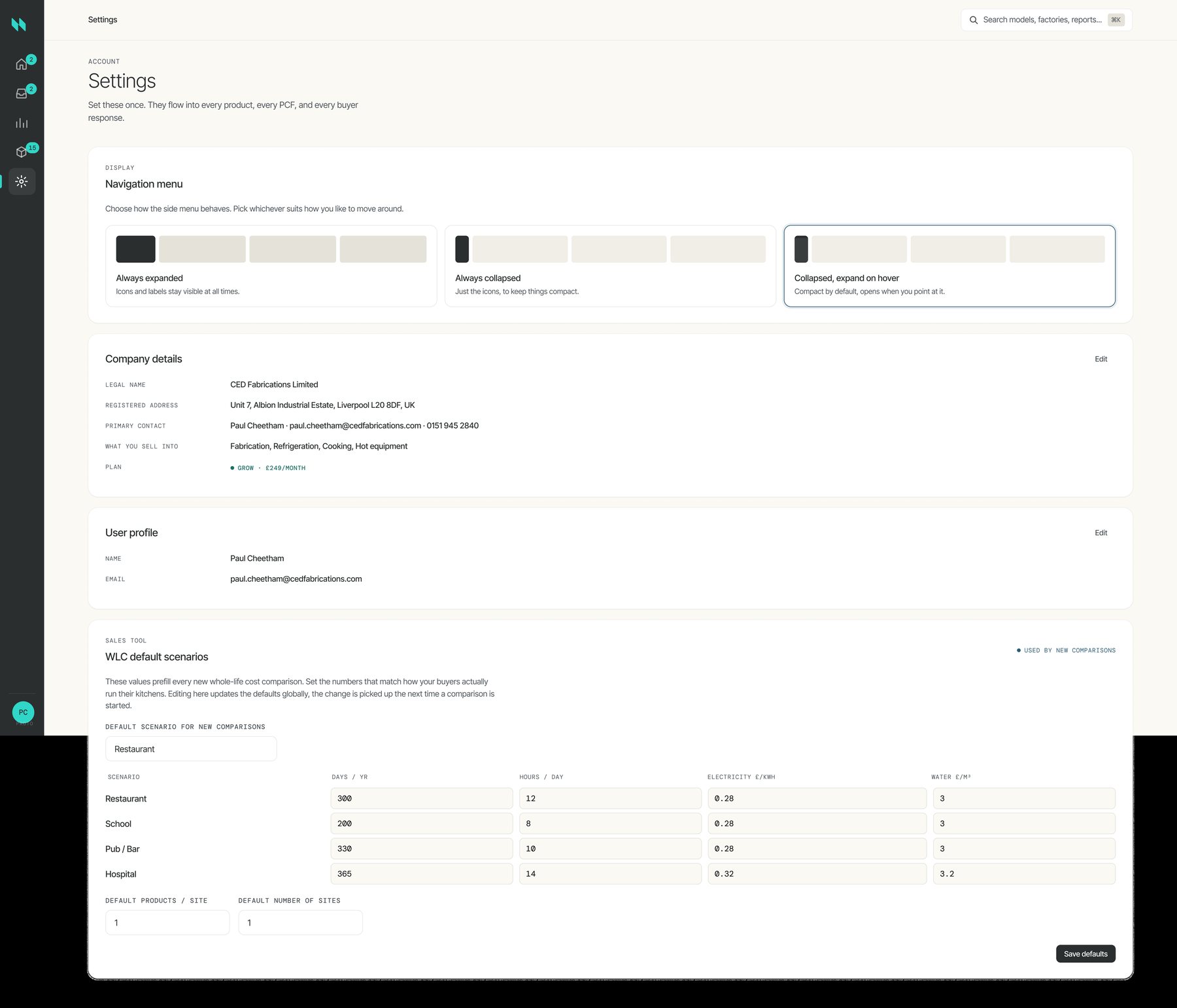
Settings that flow everywhere: company defaults and per-sector scenarios that prefill every new comparison.
To deliver a cohesive, production-ready product without sacrificing speed, we built a hybrid component library on shadcn/ui: applying our brand palette, typography and spacing tokens to ship a consistent UI fast. On top of it I engineered the domain-specific components Niscai hinges on: whole-life-cost comparison tables, scenario-modelling inputs, benchmarking charts and KPI dashboards, all token-driven, accessible and composable.
Versioned in Storybook and documented for developers, the system cut component-creation time by 60% while keeping a unified visual language across dashboards, checkout and marketplace, a maintainable, future-proof foundation for growth.
Niscai answers questions that are genuinely hard to know: what a product costs across its whole life, what its carbon footprint actually is. A model can produce those numbers quickly. Producing the number was never the design problem.
A buyer will not stake a procurement decision on a figure they cannot account for. So I built the AI-assisted workflows around two things. First, nobody should need to know which question to ask: the system surfaces what still needs a product carbon footprint, where catalogue coverage is thin, and which data requests are open, rather than waiting to be interrogated. Second, every estimate shows what it rests on, so the person using it can decide whether to trust it instead of being asked to take it on faith.
That is the test that matters here. Not whether the number looks impressive, but whether a buyer can defend it to their own finance team.